What Is a Mucous Cyst?
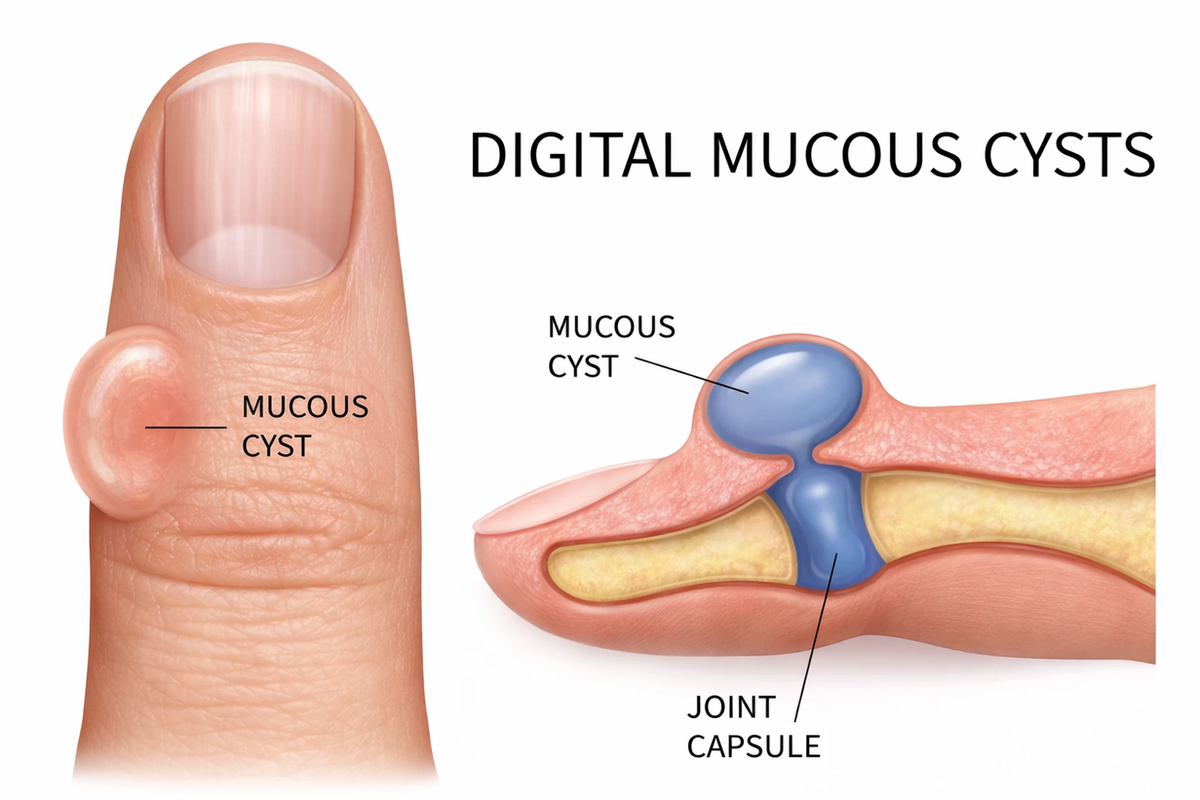
A mucous cyst — also called a digital mucous cyst or myxoid cyst — is a small, fluid-filled sac that forms near the last joint of a finger, called the distal interphalangeal (DIP) joint, or just beneath the base of the fingernail. It is benign, meaning it is not a cancer or tumor, and it typically appears as a smooth, dome-shaped bump about the size of a pea or smaller.
While the cyst itself is harmless, it is rarely a random event. In the large majority of cases, a mucous cyst is an outward sign of osteoarthritis in the underlying joint. Understanding that connection is the key to treating it in a way that actually lasts.
Why Mucous Cysts Form
The DIP joint at the end of your finger is a common site for wear-and-tear arthritis. As the cartilage in that joint breaks down, the body often forms small bone spurs, called osteophytes, along the joint margin. These spurs irritate the joint lining and cause it to produce extra fluid.
That fluid can find a path of least resistance and push outward through the joint capsule and under the skin, forming the visible cyst. In essence, a mucous cyst is arthritic joint fluid that has herniated toward the surface. This is why simply draining the cyst without addressing the joint underneath so often leads to it coming back — the source of the fluid is still there.
Signs and Symptoms
Most mucous cysts develop slowly and cause few problems at first. Common features include:
- A small, firm or slightly squishy bump near the end joint of a finger, most often on the index or middle finger
- Skin over the cyst that appears thin, shiny, or stretched
- A clear, sticky, gel-like fluid if the cyst is ever punctured or drains on its own
- A lengthwise groove, ridge, or dent in the fingernail, which happens when the cyst presses on the nail-forming tissue (the nail matrix)
- Occasional tenderness, aching, or stiffness in the joint, related to the underlying arthritis
When You Should See a Hand Surgeon
A small, painless mucous cyst can sometimes simply be watched. However, you should have one evaluated by a hand surgeon if you notice any of the following:
- The skin over the cyst becomes very thin, shiny, or starts to break down or open
- The cyst is painful, keeps returning, or is growing
- You develop a nail deformity or a groove in the nail
- There is any redness, warmth, or drainage that could signal infection
This last point deserves emphasis. Because a mucous cyst has a direct connection to the joint, a cyst that ruptures through thinned skin creates an open pathway for bacteria to travel straight into the joint. This can lead to a serious joint infection called septic arthritis. For that reason, you should never try to pop, squeeze, or drain a mucous cyst yourself with a needle at home. What looks like a simple bump is connected to a joint that must be protected.
Treatment Options
Treatment is tailored to your symptoms, the condition of the overlying skin, and how much the cyst is bothering you.
Observation
If the cyst is small, the skin over it is healthy, and it isn't causing pain or nail changes, a reasonable approach is simply to monitor it over time.
Aspiration and Injection
Draining the cyst with a needle, sometimes combined with a steroid injection, can temporarily flatten it. Because this does not address the underlying bone spur and joint fluid, however, mucous cysts treated this way frequently recur. It also carries some risk of introducing infection into the joint and is generally not a definitive solution.
Surgical Excision
For cysts that are painful, recurrent, causing nail deformity, or threatening the overlying skin, surgical removal is the most reliable treatment. The key is that a well-performed procedure does more than remove the cyst sac — it also removes the underlying osteophyte (bone spur) and addresses the arthritic joint that is producing the fluid. Treating the source, not just the symptom, is what keeps the cyst from returning.
When the skin over the cyst is badly thinned or already breaking down, a small local skin flap may be used to provide healthy coverage. In many cases, an accompanying nail deformity gradually improves over the following months as the nail grows out from a matrix that is no longer under pressure.
Recovery and Outcomes
Mucous cyst surgery is typically an outpatient procedure performed under local or regional anesthesia, meaning you go home the same day. Afterward you can expect:
- A small dressing over the fingertip and a return to most daily activities within a few days
- Stitches removed at a short follow-up visit
- A low recurrence rate when the underlying bone spur has been properly addressed
- Gradual improvement of any nail ridging or grooving over several months
With appropriate treatment, the outlook is excellent, and most patients are relieved to resolve both the cyst and the discomfort of the arthritic joint.
Expert Mucous Cyst Care in Phoenix
Dr. Todd A. Richards is a board-certified plastic surgeon with a Certificate of Added Qualification in Hand Surgery, caring for patients across five Phoenix-area locations. If you have a bump near a fingertip, a new groove in a fingernail, or a cyst that keeps coming back, an evaluation can determine the cause and the most durable treatment for your finger. Same-week appointments are typically available.