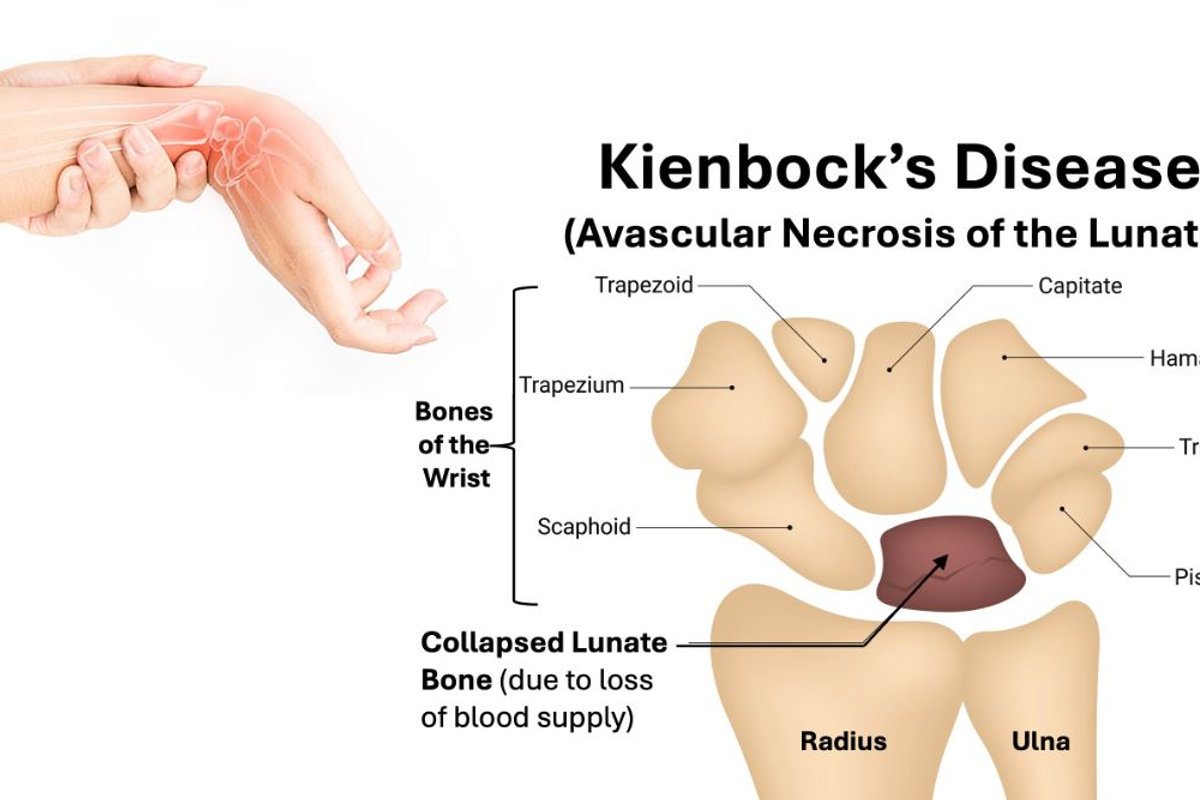
You have chronic wrist pain that won’t go away, stiffness, and weakness—but you never had a significant injury. Your X-rays may have been read as "normal" at first. If this sounds familiar, you could be dealing with Kienböck’s disease—a condition in which the lunate bone in the center of the wrist loses its blood supply and gradually dies (avascular necrosis).
What Is Kienböck’s Disease?
The lunate is one of eight small carpal bones in the wrist. It sits in a critical position at the center of the wrist joint, bearing a significant amount of force during gripping and loading. In Kienböck’s disease, the blood supply to the lunate is disrupted, causing the bone to progressively die, collapse, and fragment. This leads to wrist pain, stiffness, arthritis, and loss of function.
What Causes It?
The exact cause is not fully understood. Contributing factors include:
- Anatomic variation—a shorter ulna bone relative to the radius (ulna minus variance) increases pressure on the lunate
- Tenuous blood supply—some people have only a single vessel feeding the lunate, making it vulnerable
- Repetitive loading or trauma to the wrist
- Most commonly affects young adults (ages 20–40), particularly men in manual labor occupations
Stages of Kienböck’s Disease
The Lichtman classification stages the disease based on imaging:
- Stage I: X-rays appear normal; MRI shows decreased blood flow to the lunate
- Stage II: The lunate appears sclerotic (dense and white) on X-ray but maintains its shape
- Stage IIIA: The lunate has begun to collapse but the surrounding carpal bones maintain normal alignment
- Stage IIIB: Lunate collapse with carpal malalignment (the scaphoid rotates)
- Stage IV: Generalized wrist arthritis has developed
Diagnosis
Early Kienböck’s can be missed because initial X-rays may look normal. If I suspect the condition based on your symptoms and exam, I’ll order an MRI, which is the most sensitive test for detecting early avascular necrosis. CT scan is helpful for evaluating the degree of lunate collapse in later stages.
Treatment Options
Treatment depends on the stage:
EARLY STAGES (I–II)
Immobilization and activity modification may be tried. Joint leveling procedures—such as radial shortening osteotomy (shortening the radius bone to unload the lunate) or ulnar lengthening—can reduce pressure on the lunate and may allow revascularization.
INTERMEDIATE STAGES (IIIA)
Options include joint leveling procedures, revascularization procedures (using a bone graft with a blood vessel to restore blood supply), or partial wrist fusions (scaphocapitate fusion).
ADVANCED STAGES (IIIB–IV)
When collapse is severe or arthritis has developed, salvage procedures such as proximal row carpectomy (removing the lunate and adjacent bones) or total wrist fusion may be necessary.
Kienböck’s Disease Evaluation in Phoenix
If you’ve been dealing with chronic wrist pain that doesn’t have a clear explanation, a thorough evaluation by a hand surgeon can uncover diagnoses like Kienböck’s disease that may have been missed. I see patients from across the Valley—Phoenix, Scottsdale, Mesa, Chandler, Gilbert, Peoria, Goodyear, and Buckeye.
Call (602) 258-4788 or visit toddrichardsmd.com to book an appointment with Dr. Todd Richards. Most insurance plans accepted. Same-week appointments often available.