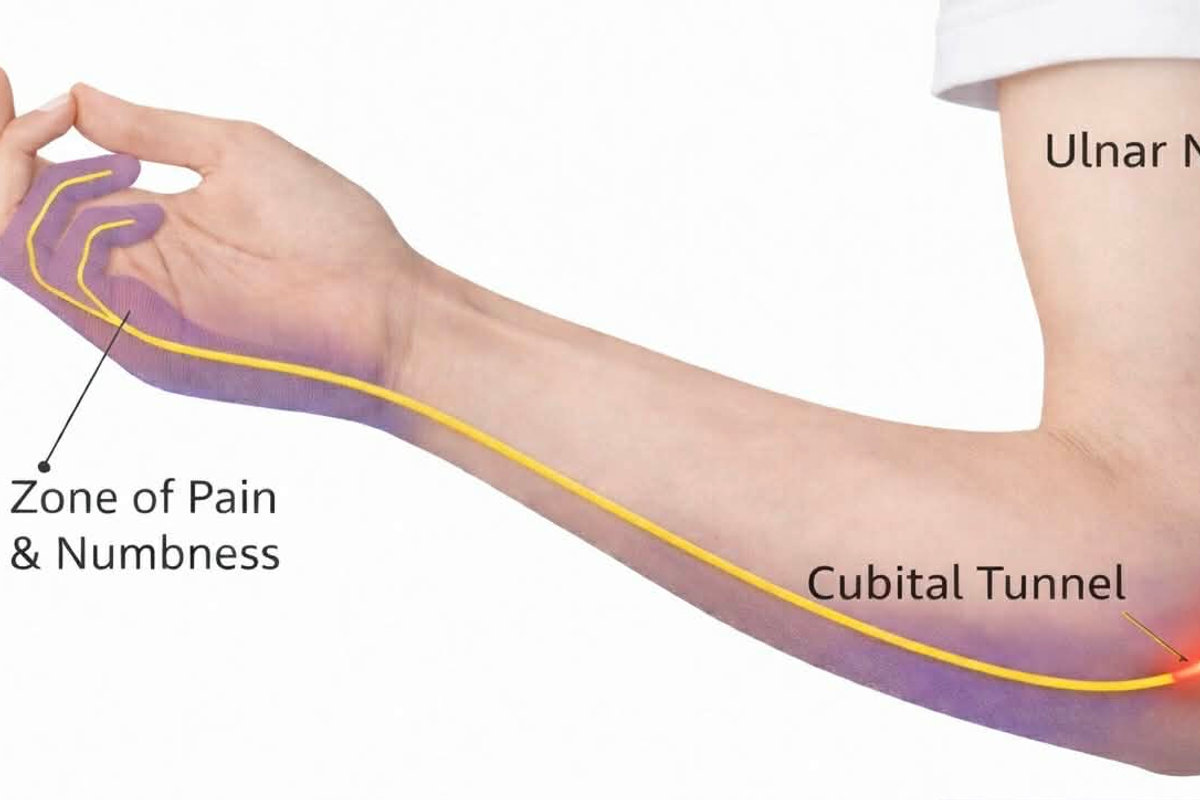
If you’re experiencing numbness or tingling in your ring and small fingers—especially when your elbow is bent—you may have cubital tunnel syndrome. This condition is the second most common nerve compression in the upper extremity (after carpal tunnel syndrome) and involves the ulnar nerve at the elbow.
The ulnar nerve is the "funny bone" nerve. When you hit your elbow on a hard surface and feel that electric shock down to your small finger—that’s the ulnar nerve. In cubital tunnel syndrome, this nerve is chronically compressed or irritated as it passes through a tight space behind the inside of the elbow.
What Causes Cubital Tunnel Syndrome?
- Prolonged elbow flexion—sleeping with elbows bent, holding a phone to your ear, or resting elbows on a desk
- Repetitive bending of the elbow
- Direct pressure on the inner elbow (leaning on armrests)
- Previous elbow fracture, dislocation, or arthritis
- Ulnar nerve subluxation—the nerve slides back and forth over the bony prominence with elbow bending
Symptoms
- Numbness and tingling in the ring and small fingers, especially with elbow bending
- Symptoms often worse at night or when holding a phone
- Aching pain on the inner side of the elbow
- Weakness in grip and pinch strength
- Difficulty with fine motor tasks (buttoning shirts, typing)
- In advanced cases, visible muscle wasting in the hand (intrinsic atrophy) and clawing of the ring and small fingers
An important distinction: carpal tunnel syndrome affects the thumb, index, and middle fingers. Cubital tunnel syndrome affects the ring and small fingers. If both areas are numb, you may have both conditions.
Diagnosis
Diagnosis involves a physical examination and nerve conduction studies (NCS/EMG). The nerve conduction study measures how fast electrical signals travel through the ulnar nerve at the elbow. Slowing at the elbow confirms the diagnosis and helps determine severity.
Non-Surgical Treatment
For mild to moderate cases:
- Elbow pad or nighttime elbow splint—keeps the elbow straight during sleep, which is when many patients unconsciously flex the elbow and worsen nerve compression
- Activity modification—avoid prolonged elbow flexion and direct pressure on the inner elbow
- Nerve gliding exercises—gentle exercises that help the ulnar nerve move more freely through the cubital tunnel
When Is Surgery Needed?
Surgery is recommended when symptoms persist despite conservative treatment, when nerve conduction studies show significant compression, or when there is muscle weakness or atrophy. Surgical options include:
IN SITU DECOMPRESSION
The roof of the cubital tunnel is released, giving the nerve more room. This is the simplest option and works well when the nerve is compressed but stays in place during elbow motion.
ULNAR NERVE TRANSPOSITION
The nerve is moved from behind the elbow to in front of it, placing it in a position where it is no longer stretched or compressed during elbow bending. This is my preferred approach when the nerve subluxes (slides over the bone) or when there is significant scarring around the nerve.
Recovery
- Weeks 1–2: Splint protection, gentle finger and wrist motion
- Weeks 2–4: Begin gentle elbow motion, sutures removed
- Weeks 4–8: Progressive activity, most patients return to desk work by 2–3 weeks and physical work by 6–8 weeks
- Months 3–12: Nerve recovery is gradual. Numbness may take months to improve. The earlier surgery is performed (before muscle wasting), the better the outcome.
Ulnar Nerve Care in Phoenix
If you’re experiencing numbness in your ring and small fingers, don’t ignore it. Early evaluation and treatment can prevent permanent nerve damage. I see patients from across the Phoenix metro—Scottsdale, Mesa, Chandler, Gilbert, Peoria, Goodyear, Buckeye, and Fountain Hills.
Call (602) 258-4788 or visit toddrichardsmd.com to book an appointment with Dr. Todd Richards. Most insurance plans accepted. Same-week appointments often available.